|
GeoModel - GeoModelCore
|
A GeoPhysVol is a physical volume for normal recursive access only. This means, normally, that it represents a piece of detector that nobody cares about except for tracing engines like GEANT. More specifically: More...
#include <GeoPhysVol.h>
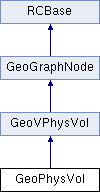
Public Member Functions | |
| GeoPhysVol (const GeoLogVol *LogVol) | |
| GeoPhysVol (const GeoPhysVol &right)=delete | |
| GeoPhysVol & | operator= (const GeoPhysVol &right)=delete |
| void | add (GeoGraphNode *graphNode) |
| virtual unsigned int | getNChildVols () const override final |
| Returns the number of child physical volumes. | |
| virtual PVConstLink | getChildVol (unsigned int index) const override final |
| Returns the ith child volume. | |
| virtual GeoTrf::Transform3D | getXToChildVol (unsigned int index, const GeoVAlignmentStore *store=nullptr) const override final |
| Returns the transform to the ith volume. | |
| virtual GeoTrf::Transform3D | getDefXToChildVol (unsigned int index, const GeoVAlignmentStore *store=nullptr) const override final |
| Returns the default transform to the ith volume. | |
| virtual void | exec (GeoNodeAction *action) const override final |
| Executes a GeoNodeAction. | |
| virtual std::string | getNameOfChildVol (unsigned int i) const override final |
| Returns the name of the child. | |
| virtual Query< int > | getIdOfChildVol (unsigned int i) const override final |
| Returns the id of the child. | |
| virtual unsigned int | getNChildVolAndST () const override final |
| Returns the number of child physical volumes and Serial Transformers. | |
| virtual GeoTrf::Transform3D | getX (const GeoVAlignmentStore *store=nullptr) const override final |
| virtual GeoTrf::Transform3D | getDefX (const GeoVAlignmentStore *store=nullptr) const override final |
| virtual unsigned int | getNChildNodes () const override final |
| virtual const GeoGraphNode *const * | getChildNode (unsigned int i) const override final |
| virtual const GeoGraphNode *const * | findChildNode (const GeoGraphNode *n) const override final |
 Public Member Functions inherited from GeoVPhysVol | |
| GeoVPhysVol (const GeoLogVol *LogVol) | |
| GeoVPhysVol (const GeoVPhysVol &right)=delete | |
| GeoVPhysVol & | operator= (const GeoVPhysVol &right)=delete |
| bool | isShared () const |
| Query< unsigned int > | indexOf (PVConstLink daughter) const |
| PVConstLink | getParent () const |
| Gets the parent, if the parent is unique, and otherwise returns a nullptr pointer. | |
| const GeoLogVol * | getLogVol () const |
| Returns the logical volume. | |
| void | apply (GeoVolumeAction *action) const |
| virtual void | dockTo (GeoVPhysVol *parent) |
| Public Member Functions inherited from RCBase | |
| void | ref () const |
| void | unref () const |
| unsigned int | refCount () const |
Private Attributes | |
| std::vector< const GeoGraphNode * > | m_daughters |
| std::mutex | m_muxVec |
A GeoPhysVol is a physical volume for normal recursive access only. This means, normally, that it represents a piece of detector that nobody cares about except for tracing engines like GEANT. More specifically:
The position of the physical volume is not kept with the physical volume. It can easily be obtained by traversing detector graph (ComputeTransformAction), but it cannot be obtained in constant time. If you need to know the absolute default and/or aligned position of the detector, you need to use a different kind of physical volume called a GeoRAPhysicalVolume, which has a higher memory cost.
Definition at line 31 of file GeoPhysVol.h.
 1.8.11

